By: Dagny Tombaugh
Who Was Charlotte Perkins Gilman?
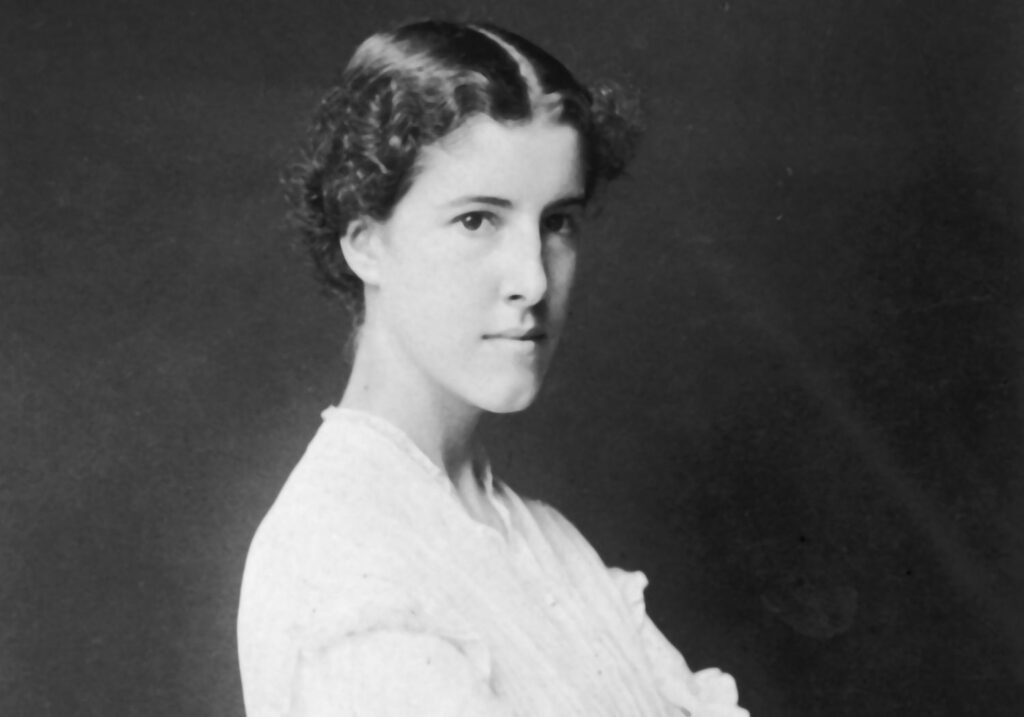
Photo of Gilman In Her Early 20’s
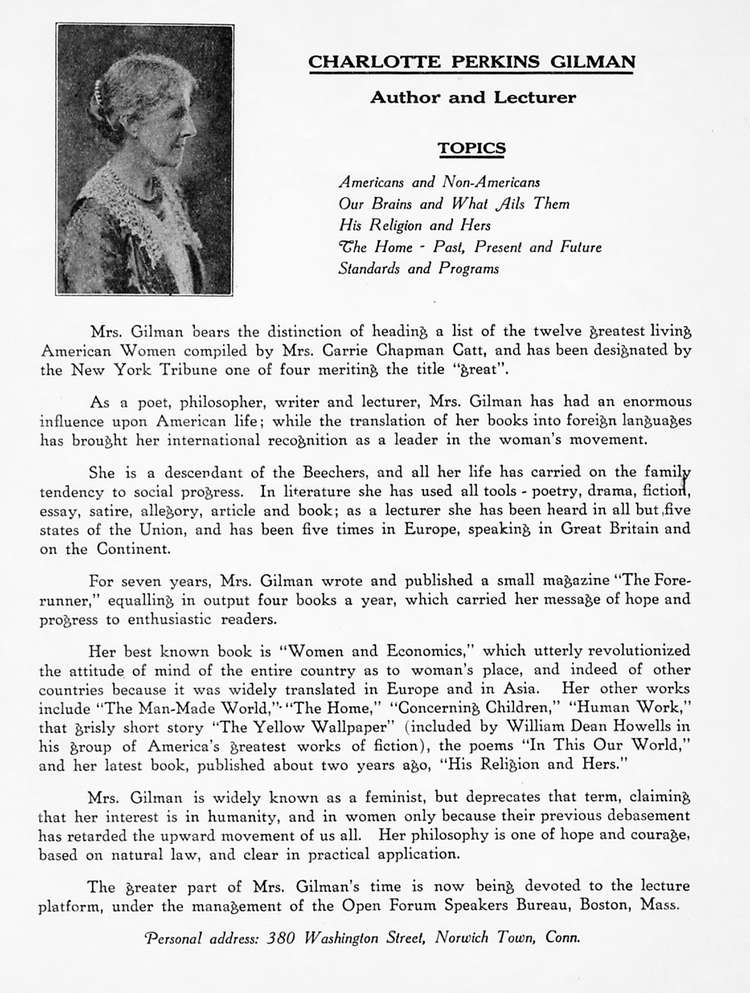
Charlotte Perkins Gilman was a prominent American feminist, novelist, and social reformer. She was born on July 3rd, 1860 in Hartford, Connecticut and died on August 17th, 1935 in Pasadena California (Prahl). In an biography about Gilman’s life, Amanda Prahl, who has received a MFA in dramatic writing from Arizona State University, claims that Gilman is best known for her influential feminist writings and her seminal short story “The Yellow Wallpaper.” Gilman was a significant member of the first-wave feminist movement, having been influenced greatly by her aunt, Harriet Beecher Stowe (Prahl). She advocated for women’s economic independence, social equality, and reform of traditional gender roles as seen through many of her works. Due to her writing, lectures, and women’s rights activism, she challenged the notions of women’s place in society during her time, arguing for women’s right to work, education, and fulfillment beyond traditional domestic life (Prahl). Her works were essential in advancing feminist thought and social reform during the late 19th and early 20th centuries (Prahl).
Contextualizing and Summarizing The Story
While having written many famous works, one of Gilman’s most prominent and horrifying pieces is the “Yellow Wallpaper.” The short story tells the story of a nameless woman suffering from mental health issues after having given birth. The woman is confined to a room and treated with a “rest cure” by her husband John, a doctor. Halle Butler, a novelist and writer for The Paris Review, states that “the woman becomes increasingly obsessed with the room’s yellow wallpaper, which seems to come alive in her own imagination” (Butler). As she descends into madness, the wallpaper becomes a powerful representation to Gilman of the oppression and lack of freedom women experienced in the 19th century. Published in 1892 in the New England Magazine (Hall 5), the story is a critical and almost satirical analysis of the medical treatment of women at the time. The story is also written from Gilman’s own personal experience with the “rest cure” after giving birth to her only child, Katharine (Butler). It is now considered a feminist work that exposes the psychological damage caused by oppressing women’s freedom and health during the era (Butler).
“The Yellow Wallpaper” Video Summary
What is the “Rest Cure?”
Charlotte Perkins Gilman herself underwent this treatment and found it deeply harmful. Her experience directly inspired “The Yellow Wallpaper,” which critiqued the medical approach to women’s mental health and the destructive nature of the rest cure. The “rest cure” was a popular medical treatment in the late 19th century, primarily prescribed to women suffering from nervous disorders or mental health issues, most specifically after giving birth. In modern day lingo, the “rest cure” would be considered treatment for postpartum depression (Stiles). Developed by physician Silas Weir Mitchell, the treatment involved complete bed rest, isolation, and total restriction of physical and mental activity. Patients were typically confined to bed, as seen in the story, and forbidden from engaging in any intellectual or physical work, and forced fed, massaged, and electrically stimulated (Stiles).
For women, this cure often meant complete social and intellectual isolation. They were not allowed to read, write, work, or have meaningful social interactions (Stiles), as seen in the story. The treatment was based on the incorrect belief that mental exhaustion and depression could be cured by absolute physical and mental inactivity (Stiles). In reality, this approach often worsened patients’ mental health, leading to increased depression, anxiety, and feelings of helplessness as expressed by Gilman.
Dr. Silas Weir Mitchell
In her autobiography, The Living of Charlotte Perkins Gilman, Gilman describes her own experience with by Dr. Mitchell. After she was brought to be treated by him in 1886 (Marland), she described her treatment plan by saying, “I was put to bed, and kept there. I was fed, bathed, rubbed, and responded with the vigorous body of twenty-six. As far as he could see there was nothing the matter with me, so after a month of this agreeable treatment he sent me home with this prescription: “Live as domestic a life as possible. Have your child with you all the time. . .. Lie down an hour after each meal. Have but two hours’ intellectual life a day. And never touch pen, brush, or pencil as long as you live.””(96)
Dr. Silas Weir Mitchell, born 1829 and died 1914, was a prominent American neurologist and physician from Philadelphia who made significant contributions to medical science during the late 19th century (Stiles). He is best known for developing the “rest cure” treatment, as previously mentioned, for neurasthenia, postpartum depression, and other nervous disorders, particularly in women. During the American Civil War, Mitchell worked as a military surgeon and became a leading researcher in nerve injuries from bullet wounds, studying nerve pain and developing important neurological treatments (Stiles). Dr. Mitchell was a leading physician of his time, serving as a consultant to many prominent and wealthy families and treating numerous notable patients. While his “rest cure” treatment is now widely criticized for its harmful psychological effects. Gilman, in her story, “depicts Mitchell as a medical villain, and the rest cure as a Gothic torture” (Stiles).

Knowing What We Know About the “Rest Cure,” How Does It Affect How We Interpret the Story?
Knowing what we know about Dr. Mitchell’s rest cure now, it greatly affects the way one can interpret the text. Gilman’s personal encounter with Dr. Mitchell and her experience with the “rest cure” offer a deeper understanding into the psychology of the nameless woman in the story. Overall, the main themes in “The Yellow Wallpaper” that can change our original interpretation of the text with this contextualization are gender oppression and critique, and the idea of the narrator’s identity being suppressed.
Gender Oppression and Critique
John, the woman’s husband, embodies a certain patriarchal authority throughout the story in his beliefs that he knows what is best for her. The author discusses how her husband claims there is technically nothing wrong with her by stating, “If a physician of high standing, and one’s own husband, assures friends and relatives there is really nothing the matter with one but temporary nervous depression – a slight hysterical tendency – what is one to do?” (Gilman 648). The quote revealing a woman’s powerlessness becomes even more horrifying when one knows that the rest cure was a real medical treatment that physically and mentally imprisoned women under the guise of healing. By forcing patients into complete isolation, forbidding intellectual or physical activity, and subjecting them to total male medical authority, the rest cure was less a treatment and more a mechanism of social control (Hall 6). Gilman’s quote powerfully exposes how a “physician of high standing” and “one’s own husband” could systematically disempower women in medical and social ways, using diagnoses like “temporary nervous depression” to invalidate women’s genuine emotional and mental experiences. The rhetorical question “what is one to do?” becomes a criticism of a system that stripped women of their agency, making them voiceless and trapped within patriarchal structures that defined their reality. By drawing from her own traumatic experiences with the rest cure, Gilman transforms a personal experience into a critique of 19th-century gender oppression.
Identity Suppression
On a similar note, , as the woman continues her isolation in the room, she begins to descend into madness, personifying the wallpaper more and more. As the woman stares at the wallpaper, it represents a pivotal moment in the narrator’s descent into madness when she says, “I sometimes think there are a great many women behind, and sometimes only one, and she crawls around fast, and her crawling shakes it all over” (Gilman 654). In this quote, her perception of the wallpaper transforms from an inanimate object to a living presence that she believes is haunting her. The imagery of a woman “crawling” behind the wallpaper is a powerful metaphor for the oppressed female experience in 19th-century society. The uncertain language—”sometimes a great many women” and “sometimes only one”—reflects the narrator’s agonized mental state and Gilman’s own feelings of imprisonment during her time of confinement. The quote also explores female oppression through its imagery. The shifting perspective of “a great many women” to “only one” suggests the collective and individual nature of women’s suppressed identity as people. The woman’s “crawling” represents a desperate attempt to break free, with the wallpaper symbolizing societal constraints (Stiles). Phrases like “crawls around fast” and “shakes it all over” imply an internal rebellion against the current confinement the narrator is in, but also on a societal level. Just as the narrator is physically trapped in a room and forbidden from writing, Gilman herself fought against similar restrictions, using this metaphorical “crawling” as a powerful representation of women’s struggle to assert their identity in a society that limits their freedom, and self-expression (Stiles).
Works Cited
Butler, Halle. “The Trouble with Charlotte Perkins Gilman.” The Trouble with Charlotte Perkins Gilman, The Paris Review, 11 Mar. 2021, www.theparisreview.org/blog/2021/03/11/the-trouble-with-charlotte-perkins-gilman/.
Gilman, Charlotte Perkins. The Living of Charlotte Perkins Gilman: An Autobiography. Madison: U of Wisconsin P, 1990. Print.
Gilman, Charlotte Perkins. The Yellow Wallpaper. Virago Press, 1981.
Hall, Thelma R. “Charlotte Perkins Gilman’s ‘The Yellow 111/_. Mper’: A Surrealistic Portrayal of a Woman’s Arrested Development.” ED370113, ERIC, 1994, files.eric.ed.gov/fulltext/ED370113.pdf.
Marland, Hillary. “The Yellow Wallpaper: A 19th-Century Short Story of Nervous Exhaustion and the Perils of Women’s ‘Rest Cures.’” The Conversation, 30 Oct. 2024, theconversation.com/the-yellow-wallpaper-a-19th-century-short-story-of-nervous-exhaustion-and-the-perils-of-womens-rest-cures-92302#:~:text=The%20story%20highlights%20the%20plight,deemed%20even%20more%20at%20risk.
Prahl, Amanda. “Biography of Charlotte Perkins Gilman, American Novelist.” ThoughtCo, ThoughtCo, 5 Nov. 2019, www.thoughtco.com/biography-of-charlotte-perkins-gilman-4773027.
Stiles, Anne. “Anne Stiles, ‘The Rest Cure, 1873-1925.’” BRANCH, Oct. 2012, branchcollective.org/?ps_articles=anne-stiles-the-rest-cure-1873-1925.