“Virginia and Maryland in Colonial times enacted strong laws against racial intermarriage, which continued in force until 1967” (Monahan 217).
By: Elijah Kali | December 10, 2024

Richard and Mildred Loving, 1967
Octavia Butler: Kindred

Octavia Butler’s Kindred is a science fiction novel that explores African-American history. Octavia Butler, born in 1947, was a “pioneering writer of science fiction” (Rothberg). She was one of the first African-American women to write in the genre and focused primarily on themes of injustice towards African Americans, global warming, women’s rights, and political disparity. Kindred, published in June 1979, features an interracial couple, Kevin Franklin (White), and Dana Franklin (African American), who live in Los Angeles, California during 1976. Yet, Dana finds herself traveling back in time to the early 1800s antebellum south. She travels there when Rufus Weylin, son of plantation owner Tom Weylin, finds himself in trouble. The relationship between Dana and Rufus is complex as Dana, a distant relative of Rufus, must rely on him to continue her familial line despite the unfortunate actions she observes, while Rufus must trust Dana to save him when he’s in trouble. Their relationship defies a typical White/African American “friendship” of the time and that angers many. Throughout her progressively longer trips, Dana observes the harsh realities of slave life in Maryland in the early 1800s. She travels back with Kevin once, and the disparity between the way the two are treated is glaringly obvious. Throughout Kevins time there he gradually accommodated to the lifestyle and the power of conformity and its role in slavery can be observed. The novel concludes with Dana stabbing Rufus, ending their connection and allowing her to move on with her life the best she can. Critics of the novel mourned the atrocities discussed yet respected the writing and the conversations that that novel brought up. Through raising awareness of the past in such a vibrant way, “Butler delivered a new understanding of how the present is furnished with ultimate simplicity” (Arige 4). In other words, basic rights often taken for granted now are only possible as a result of the years of struggle faced by generations past.
Interracial Marriage in the US: An Overview
In historical documents, miscegenation is the technical term for marriage between ethnic groups, specifically when one of the partners is white. The Jim Crow Museum notes that “Laws prohibiting miscegenation in the United States date back as early as 1663” (The Jim Crow Museum). The United States, home of the free and land of the brave, failed to federally redact these laws until 1967 (Monahan 217). This fact helps introduce the atrocities of American history that many overlook.
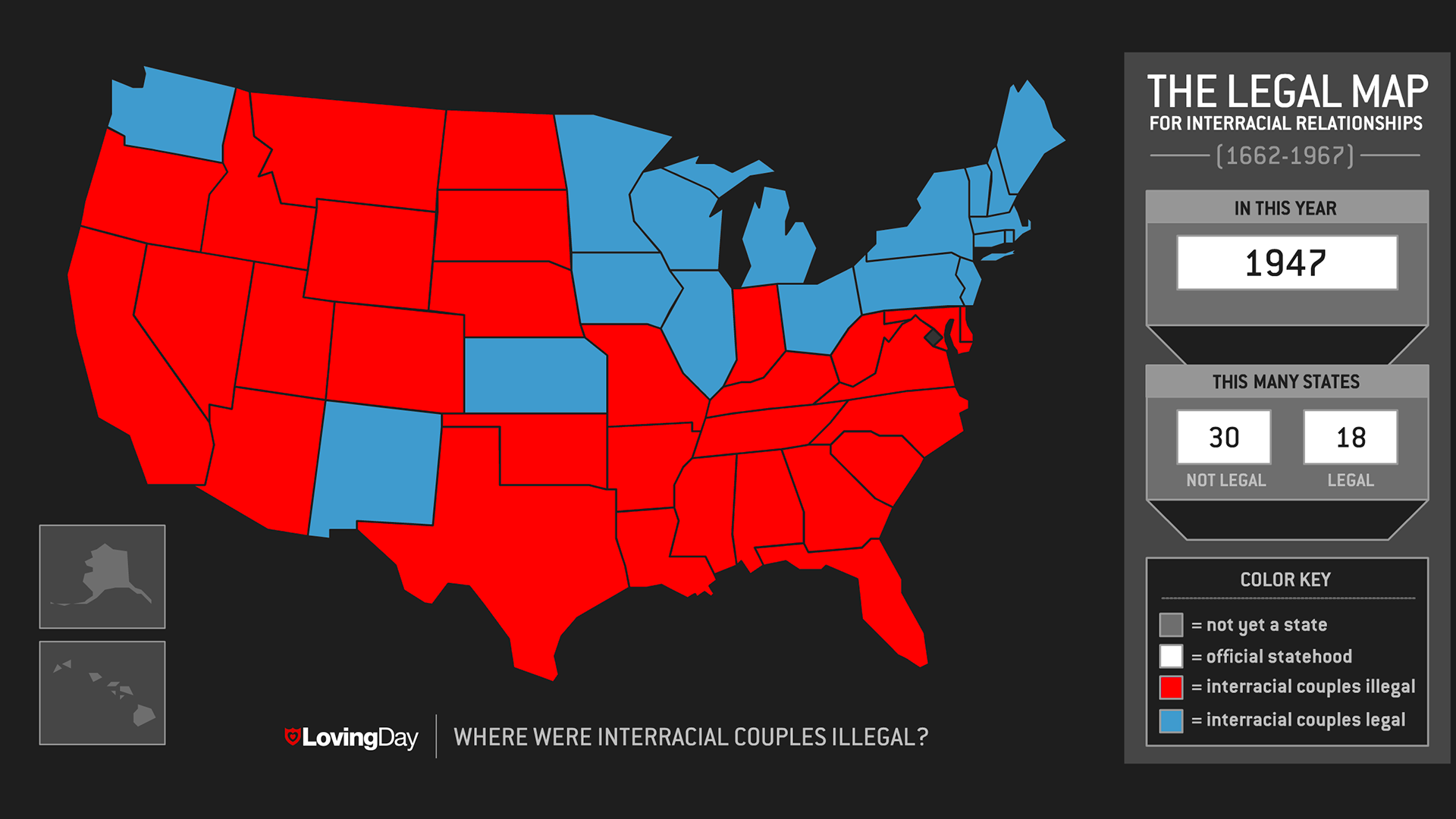
Although slavery was abolished in 1865, interracial couples still faced extreme obstacles throughout the 20th century (National Archives). A 2018 Daily Mail article investigates specific cases of interracial couples during times of bans, and the extensive path they often took in order to be together. The “[criminalization of] sexual relations and cohabitation,” resulted in couples having to flee their home state (or even country) in order to safely marry one another (Carter). Even in states where marriage was legal, oftentimes couples would lie on their official documents claiming both parties “colored” as a precautionary measure. Harsh punishments, which varied by state, often included up to $100 in fines (more than $10,000 when adjusted for inflation), up to 10 years in prison, and the marriage would become immediately void (Barnett 95).

Interracial marriage laws were put on center stage in the mid-20th century during a Virginia court ruling. Lovings v Virginia is the case about a couple Mildred and Richard Loving, who married in DC and lived in Virginia. They were picked up from their room and brought to jail in the middle of the night as a result of violating Virginia anti-miscegenation laws. Banished from the state in 1959, shortly after, in 1963 they decided to take a stand. As the case was brought back to court, they struggled as the initial judge felt as though their marriage was still “‘absolutely void in Virginia,’ and they could not ‘cohabit’ there” (Wallenstein 40). Through an extensive appeal process the case was eventually brought before the US Supreme Court in which judges claimed current Virginia laws were “‘relics of slavery’ and, at the same time, ‘expressions of modern day racism’” (Wallenstein 40). The Supreme Court unanimously ruled that states must defer to the 14th amendment in regard to marriage laws as current bans on marriage were “designed to maintain White Supremacy” (Wallenstein 41). In 2013 Ilya Shapiro, former vice president of the Cato Institute, interpreted the 14th amendment and its pertainment to miscegenation laws:
“As the text and history of the Fourteenth Amendment plainly show, the clause guarantees every individual—whether black or white, man or woman, gay or straight, native-born or immigrant—equality under the law, including the legal right to marry the person of one’s choosing.” (Shapiro)
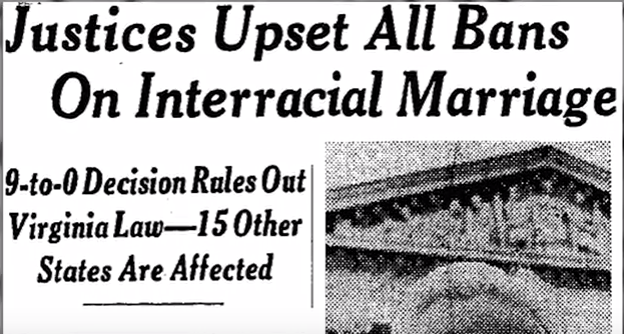
Lovings v Virginia
Maryland, where Butler’s Kindred takes place, was the first state to enact anti-miscegenation laws in 1664 (Equal Justice Initiative). They had to adjust their laws following the Supreme Court ruling on Lovings v Virginia finally ending the marriage ban over 300 years since its origination. Although it was no longer illegal, interracial couples still faced adversity socially. Data from a Pew Research Center analysis of US Census Bureau data shows that in the years following the ruling, just 3% of newlyweds were interracial couples (Gretchen Livingston and Anna Brown). Although it took until 2000 for the last state banning miscegenation, Alabama, to concede, the Pew Research data has shown a steady increase in the rates of interracial marriage as well as the acceptance of interracial marriage amongst all racial groups since the original data was collected (Bump).

Graph showing that since 1967, there has been a steady increase in US interracial marriages

Butlers’ Purpose
Research on the intricacies of interracial marriage laws adds perspective and furthers some of the horrors observed within the novel Kindred. Butler’s use of multiple time periods in her works allowed for the comparison between the two. The early 1800s with slavery at its worst in the United States and in 1976 where all citizens were considered equal under the US Constitution. Although legally speaking, in the present of the novel civil rights were guaranteed to all Americans, instances within the novel convey the reality that the remnants of slavery and inequality had not yet completely vanished.
In the early 1800s, it was stated that not only interracial marriage was illegal, but any sexual relations between citizens of different races were forbidden. Yet, despite this, the sexual abuse of black women by slave owners is both implicitly referenced with Tom Weylin and explicitly referenced with Rufus Weylin. When discussing Alice with Rufus, Dana observes that “There was no shame in raping a black woman, but there could be shame in loving one” (Butler 124). This observation furthers the cruel imbalance of power between slaves and slaveowners. Slavery was legal at this time so in that sense slave owners weren’t breaking the law. But the harsh treatment of black women, specifically the sexual abuse they endured, shows that not even the law could protect slaves. Sources showed that genuine love between a white and black citizen was punished harshly but when slaves were being abused, law enforcement turned a blind eye. Slave owners not only profited off the work of their slaves, but they also enjoyed having slaves’ bodies and livelihoods at their disposal.
Additionally, Butler’s use of multiple time periods gives us a glimpse into 1976, a time of apparent equality between races. Although slavery had been abolished, and miscegenation bans lifted, remnants of racism still existed at the time of this novel. During the 1976 segment of this novel, Butlers writes of an interesting interaction between Dana and her husband Kevin:
“The third time when I refused again, [Kevin] was angry. He said if I couldn’t do him a little favor when he asked, I could leave. So I went home.
When I rang his doorbell the next day after work, he looked surprised.
‘You came back.’
‘Didn’t you want me to?’
‘Well … sure. Will you type those pages for me now?’
‘No.’
‘Damnit, Dana …!’” (Butler 109)
This interaction comments on the unfortunate reality for black citizens in this time – although now legally equal, it was difficult to erase the internal biases and prejudice of generations past. Kevin requests that Dana do his typing for him and when she refuses, his reaction is inappropriate. Dana doesn’t ‘owe’ Kevin anything and his frustration with her taking a stand revealed an unfortunate internal bias. The bias extends further than just Kevin though, Kevin explains his sister’s reaction towards the marriage when he says, “she didn’t want to meet you, wouldn’t have you in her house – or me either if I married you’’ (Butler 110). The tension wasn’t one-sided as Dana expresses her fear to Kevin of delivering the news to her family of their marriage, “I’m afraid my aunt and uncle won’t love you” (Butler 110). This fear unfortunately stems purely from the fact that Kevin is white. The combination of these interactions displays that even in 1976, in a legal interracial marriage, society still struggles to accept a new age and move past the country’s grim history.
Being that Butler published this book in 1979 and it took place in 1976, it’s safe to assume Butler was commenting on the realities she’s observed in this country. The novel tells a story of a country whose societal acceptance of civil rights lags behind the legal components. Whether she experienced some form of racism firsthand or heard an account, Butler uses her novel Kindred to expose the unfortunate realities of slave life in the 1800s while also commenting on the fact that growth still needed to occur in the US. The development of marriage laws helped display the remnants of slavery that continued to haunt our country until 1964 and the aftermath of those laws in the years after. Not to disregard the progress the US has made, but it’s clear, through Butler’s storytelling and through the research conducted, that there was still progress to be made at this time.
Work Cited
Arige, Nouf A. “The Journey of Return: Reviving the Past to Redefine the Present.” CUNY Academic Research , 2019, academicworks.cuny.edu/cgi/viewcontent.cgi?article=1177&context=si_pubs. Accessed 30 Nov. 2024.
Barnett, Larry D. “Anti-Miscegenation Laws.” The Family Life Coordinator, vol. 13, no. 4, 1964, pp. 95–97. JSTOR, https://doi.org/10.2307/581536. Accessed 11 Dec. 2024.
Bump, Philip. “Alabama Was a Final Holdout on Desegregation and Interracial Marriage. It Could Happen Again on Gay Marriage. – The Washington Post.” The Washington Post, 9 Feb. 2015, www.washingtonpost.com/news/the-fix/wp/2015/02/09/alabama-was-a-final-Holdout-on-desegregation-and-interracial-marriage-it-could-happen-again-on-gay-marriage/. Accessed 30 Nov. 2024.
Butler, Octavia E. Kindred. Beacon Press, 2008.
Carter, Hana. “The Brave American Couples Who Refused to Let Prejudice Tear Them Apart.” Daily Mail Online, Associated Newspapers, 18 Jan. 2018, www.dailymail.co.uk/femail/article-5283243/19th-Century-images-capture-brave-interracial-couples.html. Accessed 11 Dec. 2024.
Equal Justice Initiative. “Maryland Passes Colonies’ First Law Opposing Interracial Marriage.” Equal Justice Initiative, 20 Sept. 2024,calendar.eji.org/racial-injustice/sep/20#:~:text=Sep%2020%2C%201664-,Maryland%20Passes%20Colonies%27%20First%20Law%20Opposing%20Interracial%20Marriage,intended%20to%20prevent%20interracial%20marriage. Accessed 11 Dec. 2024.
Jim Crow Museum “Laws That Banned Mixed Marriages.” Jim Crow Museum, 2010,jimcrowmuseum.ferris.edu/question/2010/may.htm#:~:text=Laws%20prohibiting%20miscegenation%20in%20the,Vginia%27s%20miscegenation%20laws%20were%20unconstitutional. Accessed 30 Nov. 2024.
Livingston, Gretchen. “Intermarriage in the U.S. 50 Years after Loving v. Virginia.” Pew Research Center, 18 May 2017, www.pewresearch.org/social-trends/2017/05/18/intermarriage-in-the-u-s-50-years-after-loving-v-virginia/#fn-39684-2. Accessed 30 Nov. 2024.
Monahan, Thomoas P. “Interracial Marriage in a Southern Area: Maryland, Virginia, and the District of Columbia.” Journal of Comparative Family Studies, vol. 8, no. 2, 1977, pp. 217–41. JSTOR, http://www.jstor.org/stable/41601008. Accessed 30 Nov. 2024.
National Archives and Records Administration. “13th Amendment to the U.S. Constitution: Abolition of Slavery (1865).” National Archives and Records Administration, 10 May 2022, www.archives.gov/milestone-documents/13th-amendment. Accessed 11 Dec. 2024.
Rothberg, Emma. “Biography: Octavia Estelle Butler.” National Women’s History Museum, www.womenshistory.org/education-resources/biographies/octavia-estelle-butler. Accessed 30 Nov. 2024.
Shapiro, IIya. “The Equal Protection Clause Guarantees the Right to Marry.” Cato Institute, 4 Mar. 2023, www.cato.org/commentary/equal-protection-clause-guarantees-rightmarry#:~:text=As%20the%20text%20and%20history,the%20person%20of%20one%27%20choosing. Accessed 30 Nov. 2024.
Wallenstein, Peter. “The Right to Marry: Loving v. Virginia.” OAH Magazine of History, vol. 9, no. 2, 1995, pp. 37–41. JSTOR, http://www.jstor.org/stable/25163014. Accessed 30 Nov. 2024.