Background on Shirley Jackson and “The Lottery”

Shirley Jackson, born in 1916 in California, is known for her horror and mystery writings, with “The Lottery” being her most famous work (Biography). Published in 1948, shortly after World War II and at the start of the Cold War, the story faced initial rejection due to its shocking and gruesome ending, which people thought was foolish and some even thought was based on real events (eNotes). Although still controversial, critics now recognize its “compelling themes and intriguing premise” (eNotes).
Summary of “The Lottery”
The short story “The Lottery” begins on a normal day, June 27th, as the townspeople gather for a lottery. Children gather first, with the boys’ collecting stones. After some socializing, families come together for the event. Mr. Summers appears with a worn black box, a symbol of tradition, as the townspeople are not willing to replace it for the sake of tradition. Just as they are about to start, Mrs. Hutchinson arrives, explaining that chores delayed her. They notice Mr. Dunbar is absent, so Mrs. Dunbar decides to draw for her family, which is frowned upon since men typically participate. Once all families are accounted for, the lottery begins.
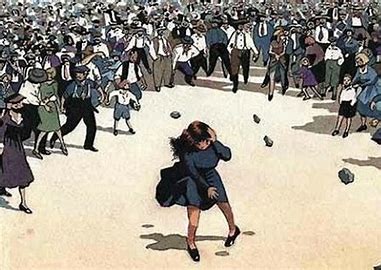
Mr. Summers calls each head of the household to draw from the box. During this, Mr. Adams mentions to Old Man Warner that some towns are abandoning the lottery. Warner dismisses the idea, arguing that the younger generation is foolish to challenge tradition, then suggesting that the lottery has benefits, saying, “Lottery in June, corn be heavy soon” (Jackson 5). After each head of the family has drawn, it’s revealed that Bill Hutchinson has the black dot. Mrs. Hutchinson protests the unfairness, but the lottery continues within her family, and Tessie Hutchinson draws the marked paper. The townspeople then stone her to death.
Significance of “The Lottery”
The story critiques a society that devalues women’s roles after childbearing, making them scapegoats who “can depend on no one” (Mambrol). Women are excluded from the drawing, and when Tessie is chosen, her family offers no protection, demonstrating her isolation. Jackson highlights the “pointless violence and general inhumanity” present in American society (Haven), showing how tradition can lead to brutality (Enotes). The townspeople’s fear of abandoning the lottery mirrors historical atrocities: World War II, the Holocaust, and the atomic bomb, demonstrating the dangers of blind willingness to partake in harmful customs under the “guise of the common good” (Enotes). In “The Lottery,” Jackson challenges a patriarchal society and exposes the violence in tradition stemming from ignorance and fear.
Why did Stonings happen in the Bible?
Throughout history, various methods of human sacrifice have been employed, including strangulation, throwing victims from heights, etc. In “The Lottery,” however, stones are used. This practice can be linked to biblical tradition, as it serves as both a means of punishment and an appeal to God.
Stoning of the Adulterous Woman
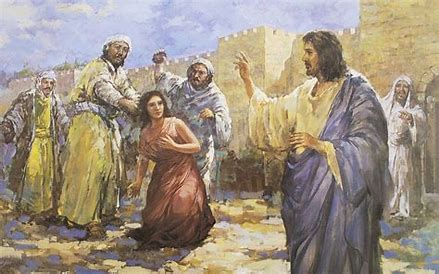
One example is the story of the adulterous woman in John 8.1-11. Caught in the act by teachers of religious law and the Pharisees, she was brought before the community to be stoned to death, as was customary for women in her situation. But Jesus saved her from this fate, pointing out that everyone there is also a sinner.
Stoning of Achan and His Family
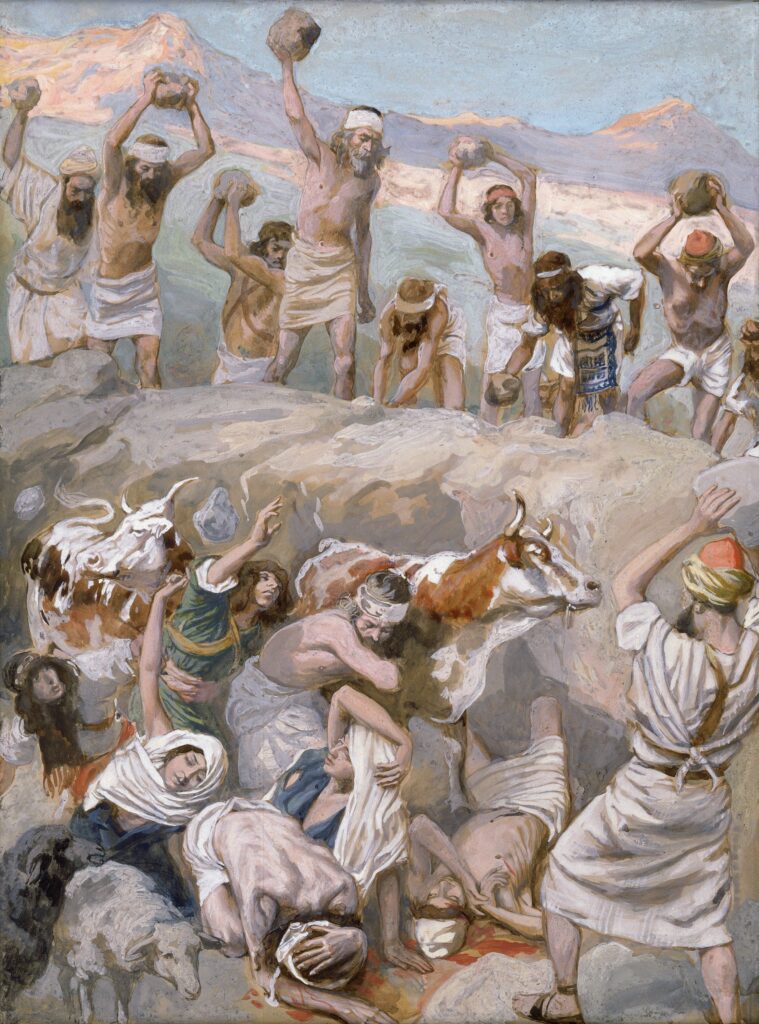
Another instance involves Achan, who, after he and the Israelites destroyed Jericho, was commanded by God not to take any of the city’s riches. Disobeying this command, Achan stole a beautiful robe, along with gold and silver. Following this sin, the Israelites were on their way to battle against the city of Ai but were unexpectedly defeated, losing 36 men to the enemy. Joshua, who had led the Israelites in their previous victory at Jericho, went to God for guidance, asking why they faced destruction and why Israel could not stand against their enemies. God replied, “I will not be with you anymore unless you destroy whatever among you is devoted to destruction” (Holy Bible, Joshua 7.12) After realizing that Achan was responsible for the sin, Joshua gathered the community of Isreal and stoned Achan and his family to death as punishment for his actions (Holy Bible, Joshua 7.1 – 25).
Why Stoning?
This leads to the question of why stoning was chosen as a means of punishment and its connection to human sacrifice. Deuteronomy states, “Then all the men of his town are to stone him to death. You must purge the evil from among you. All Isreal will hear of it and be afraid” (Holy Bible, Deuteronomy 21.21). As mentioned in the Holy Bible, the purpose of stoning is to eliminate evil from the community and instill fear as a means of control (Conway). By selecting someone for sacrifice or punishment, the community sets an example, reinforcing social order and purifying themselves of sin, by the means of ridding themselves of the person who sinned, ultimately leading to alignment with God.
As mentioned by Noor, “This practice was seen in some cultures as allowing the larger community to take part in the administration of justice. Stoning has been used since ancient times to punish the convicted” (1). The act of stoning required the community’s participation, highlighting collective responsibility in maintaining moral standards. The community is meant to come together to atone for wrongdoing, therefore putting themselves back in the favor of God and restoring order. As Shual Bar of UMemphis notes, “The entire community was obligated to participate in stoning because those who stoned the condemned person were thereby purifying themselves” (15). Everyone who takes part will benefit personally, which encourages everyone to come together and take part in the community’s and their own purification. This communal action not only led to the betterment of the community but also united its members, reinforcing the community’s togetherness.
Through stoning, communities believed they could earn God’s favor by purifying themselves of evil. Such acts of violence, while brutal, were seen as necessary for civilizing society and preventing misbehavior. The visual demonstration of the consequences for sin led to a sense of shared responsibility and sharpened the community’s moral standards as a whole, uniting the community even more. Overall, stoning was a method of purification that united the people in their commitment to uphold God’s will and ensure the collective well-being of the community.
Linking Stoning in the Bible and “The Lottery”
Benefits of conducting “The Lottery” for the Villagers
In “The Lottery,” most villagers seem to have forgotten various aspects of the ritual, yet they distinctly remember the stones, a symbol of violence and the belief that stoning is necessary for good fortune. Jackson writes, “Although the villagers had forgotten the ritual and lost the original black box, they still remembered to use stones. The pile of stones the boys had made earlier was ready… Delacroix selected a stone so large she had to pick it up with both hands” (5). This quote demonstrates the normalization of violence within the community and highlights collective participation in this brutal tradition, from the children to the adults. Mrs. Delacroix’s choice of a large stone demonstrates her belief that harming Mrs. Hutchinson will bring blessings to her family. By deliberately selecting a larger stone, she shows a willingness to inflict significant damage for the sake of a greater reward, therefore guaranteeing her own purification.
Old Man Warner mentions the benefits of the lottery, linking it to agricultural prosperity: “Lottery in June, corn be heavy soon” (Jackson 3). This suggests that the villagers believe participation in the lottery is essential for their benefit. Even though many, especially the children, have lost sight of the original tradition, they understand that engaging in this ritual is necessary to earn God’s favor over their land.
Community Purification, Morality, and Human Sacrifice
However, this collective responsibility to uphold their standing in God’s grace distorts their individual morality. This distortion is like biblical stories where individuals leave their personal ethics in the name of communal benefit. For instance, in the story of the stoning of the adulterous woman, the community comes together to condemn her, despite their own sins. In that moment, no one steps forward to protect her—except for Jesus, who intervenes. Similarly, in “The Lottery,” no one comes to Mrs. Hutchinson’s defense, illustrating how societal pressures can override individual compassion and morality.

Jackson’s story demonstrated a long-standing tradition of human sacrifice that is thought to benefit both the land and its people. Through the act of stoning, the community unites in violence, convinced that this ritual will improve their collective well-being. They seek to earn God’s favor, even in the absence of a target for punishment. This desire for divine approval is linked with a strict social order; individuals stay complaint out of fear of the violence they might face themselves. Engaging in this act of sacrifice, they believe it will bring both individual and communal blessings. In this process, no one intervenes to protect those chosen for sacrifice, highlighting a scary willingness to uphold the tradition they believe will purify their town.
Works Cited
Bar, Shaul. “Death by Stoning in the Hebrew Bible and in Post-Biblical Traditions.” Old Testament Essays, vol. 34, no. 3, June 2021, doi.org/10.17159/2312-3621/2021/v34n3a8.
Biography. “Shirley Jackson.” Biography, 6 Apr. 2021, www.biography.com/authors-writers/shirley-jackson.
Conway, Bobby. “Why Did God Allow Stoning?” Cross Examined, 12 Feb. 2024, crossexamined.org/why-did-god-allow-stoning.
eNotes “The Lottery by Shirley Jackson.” uploaded by eNotes Publishing, 2022, www.enotes.com/topics/lottery/in-depth/historical-social-context.
Haven, Cynthia. “Shirley Jackson’s ‘The Lottery’ – It Wasn’t as Easy as She Claimed.” Stanford University: The Book Haven, 24 July 2013, bookhaven.stanford.edu/2013/07/shirley-jacksons-the-lottery-it-wasnt-as-easy-as-she-claimed.
Jackson, Shirley. The Lottery. The New Yorker, 26 June. 1948
Mambrol, Nasrullah. “Analysis of Shirley Jackson’s the Lottery.” Literary Theory and Criticism, 28 May 2021, literariness.org/2021/05/28/analysis-of-shirley-jacksons-the-lottery.
Noor, Mohd A. bin. “Stoning for Adultery in Christianity and Islam and Its Implementation in Contemporary Muslim Societies”. Intellectual Discourse, vol. 18, no. 1, June 2010, doi:10.31436/id.v18i1.139.
The Holy Bible. New International Version, Biblica, 1978.