By: Ivy Gore
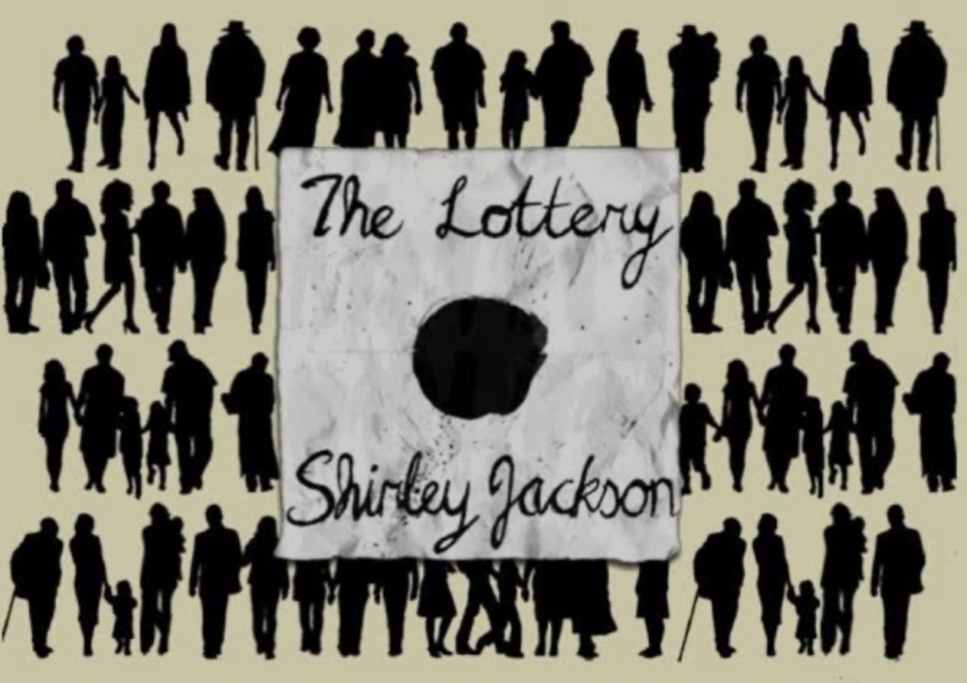
INTRODUCTION TO THE “THE LOTTERY”
The Lottery, by Shirley Jackson, is a short horror story that takes place in a small town. The lottery is a yearly raffle in which a person is chosen to be stoned by the town. The stoning and raffle is a part of a traditional ritualistic act that the townspeople believe brings a better harvest of crops. As the narrative progresses, the townspeople are anxious, but not overly alarmed by the lottery. Until almost the end of the short story, the reader is blissfully unaware of the true outcome of the lottery. When Mrs. Hutchinson— who grabs the attention of the reader due to her late arrival to the town center— receives the black mark, the reader is introduced to the reality of the lottery. Her terror and pleading is met with silence from a majority of the crowd. Her husband and children participate in her public stoning.
Shirley Jackson wrote The Lottery as a critique of conformity in the late 1940s. When Shirley Jackson published the short story in the New York Times in 1948, New York Times received “letters in droves” (Heller) from patrons who were angry about the short stories contents. Some even wrote with hopes of finding the location that these ritualistic sacrifices take place in, so that they may be able to participate. Many missed the deeper meaning of the story, or did not appreciate its attack on American culture. It was a commentary on American culture when society was moving towards a period of mindless conformity, zealous traditionalism, and blind patriotism.
This was an era in the U.S. that was marked by fear of abstractness, espionage, and hysteric paranoia. During the 1940s, Mccarthyism came about due to the ramping up of the Cold War with Russia and the Red Scare in the U.S. There was a belief that was heavily circulated through the United States that anyone who thought differently was unpatriotic (Atcher). Those who were thought to be unpatriotic usually came under suspicion of being a Communist spy, leading to their swift exile from society. Interestingly, Mrs. Hutchinson late arrival is subversive to town’s conformity of punctuality and unison. Her receiving the black mark is a nod to McCarthyism, as she swayed from the societal norms expected of her.
WHAT IS THE BYSTANDER EFFECT?
The Bystander Effect occurs when the presence of others discourages an individual from intervening in a situation, such as an assault or other crime. Social psychologists Bibb Latané and John Darley popularized the concept of the bystander effect following the murder of Kitty Genovese in NYC in 1964. The 28 year old was murdered outside her apartment. A newspaper released portions of the police report which states that “thirty-eight respectable, law-abiding citizens in Queens watched a killer stalk and stab a woman in three separate attacks in Kew Gardens… Not one person telephoned the police during the assault” (Benderly). The shock of the public’s perceived willingness to do nothing baffled viewers, leading the story to gain national attention. The New York Times later published that their source was incorrect, and only a few individuals did not aid Ms. Genovese. Despite this, the reality of her murder is chilling (Verel). This has not been the only major incident covered by news media that was the result of the Bystander Effect. In recent years, random attacks in New York during daylight which were publicized with a similar headline: no one stepped in to help the victim. The Bystander Effect is also seen on a more trivial, daily level. An example is that if you are in a group setting and everyone around you is talking very loudly, the chances of someone beginning to whisper are slim, as that goes against the social pressures of conformity. People are less apt to change a behavior when in a larger group that is doing that behavior.
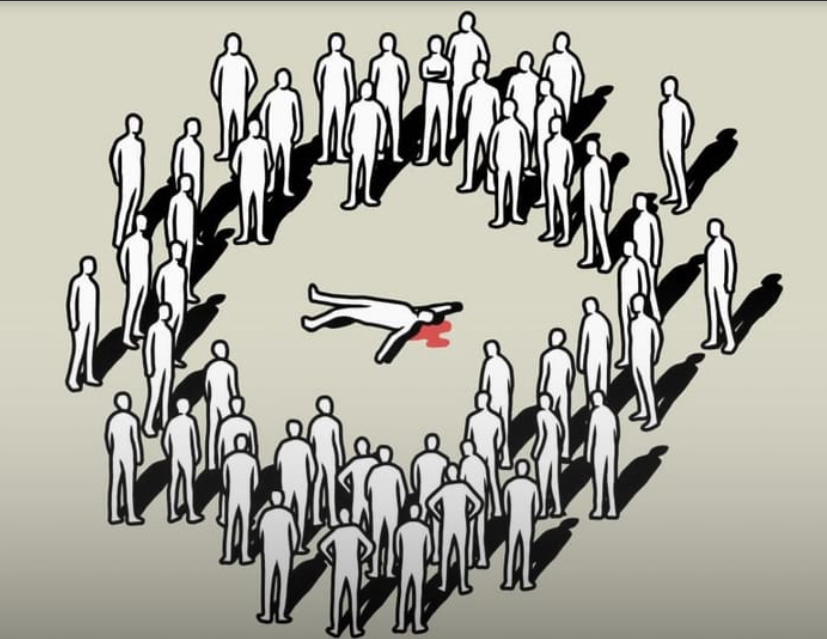
The two psychologists attributed the Bystander Effect to three factors: diffusion of responsibility, social influence, and pluralistic ignorance. 1) Diffusion of responsibility means that the more people are present, the less personal responsibility individuals will feel to take action (Blagg). 2) Social influence means that individuals are influenced by the behavior of those around them to determine how to act (Blagg). 3) Pluralistic ignorance occurs when an individual privately disagrees with a norm or behavior but will go along with what they think other members of the group are thinking (Psychology).
Another social behavior that greatly plays into the Bystander Effect—specifically factors number 2 and 3— is peer pressure. Individuals can feel peer pressured into conforming with the group norm, further leading to the Bystander Effect. Peer pressure has a similar definition to the bystander effect. Merrimack-Webster dictionary describes peer pressure as “a feeling that one must do the same things as other people of one’s… social group in order to be liked or respected.” Pluralistic ignorance and peer pressure are often referred to as cohesive social behaviors. Both social psychologies result in individuals behaving the same way as the larger group, leading to a unified conformity of thought, behavior, and action.
REEXAMINATION OF “THE LOTTERY”
The cumulation of peer pressure and the Bystander Effect can result in active participation in social action. This is present in the narrative of “The Lottery.” Two major examples that demonstrate the Bystander Effect is during the stoning of Mrs. Hutchinson and during a brief conversation between the Adams and Old Man Warner.

During the first interaction, Mr. Adams says that “…’over in the north village they’re talking of giving up the lottery.’” Which his wife, Mrs. Adams, further adds that ”’some places have already quit lotteries.’” Their acknowledgment of change as a positive for the town is quickly shot down by Old Man Warner snapping back that there is ”’nothing but trouble in that.’” By an elder member of their town ridiculing their address, they are persuaded to no longer acknowledge that idea or its potential for positive outcomes due to the need to feel accepted and abide by the expected societal conformity. This demonstrates one of the key factors in the Bystander Effect, social influence. It also further demonstrates the idea of conformity that Shirley Jackson was criticizing. Another example of Old Man Warner using his societal status to influence the social behaviors of the townspeople was during the stoning of Mrs. Hutchinson. During the stoning, while she is screaming and pleading with the hopes of someone stepping in and saving her, Old Man Warren shouts “come on, come on, everyone.” Old Man Warner encouraging people to continue in the stoning of Mrs. Hutchinson uses social influence and pluralistic ignorance to ensure the continuance of the Bystander Effect in the townspeople. This makes the cumulation of peer pressure and the bystander effect too influential for a change in behavior. Another example of the Bystander Effect was when “someone gave little Davy Hutchison a few pebbles” to throw at his mother. This further proves that the social influence of peer pressure and the Bystander Effect even breaches familial loyalty.
WORKS CITED
Atcher, Paul J. “McCarthyism.” Britannica, 23 Oct. 2024, www.britannica.com/ event/McCarthyism. Accessed 9 Dec. 2024.
Benderly, Beryl. “Psychology’s Tall Tales.” American Psychological Association, www.apa.org/gradpsych/2012/09/tall-tales. Accessed 9 Dec. 2024.
Blagg, Robert. “Bystander Effect.” Britannica, 29 Nov. 2024, www.britannica.com/ topic/bystander-effect. Accessed 9 Dec. 2024.
“Bystander Effect.” Psychology Today, www.psychologytoday.com/us/basics/ bystander-effect. Accessed 9 Dec. 2024.
Heller, Scott. “75 Years After ‘The Lottery’ Was Published, the Chills Linger.” The New York Times, 26 June 2023, www.nytimes.com/2023/06/26/books/ review/the-lottery-75th-anniversary-shirley-jackson.html. Accessed 9 Dec. 2024.
Jackson, Shirley. The Lottery. The New Yorker, 1948.
“McCarthyism and the Red Scare.” Miller Center, millercenter.org/the-presidency/ educational-resources/age-of-eisenhower/mcarthyism-red-scare. Accessed 9 Dec. 2024.
“Peer Pressure.” Merriam-Webster Dictionary, www.merriam-webster.com/dictionary/peer%20pressure. Accessed 9 Dec. 2024.
Verel, Patrick. “The Death of Kitty Genovese: A Case that Echoes to This Day.” Fordham Now, 23 Aug. 2017, now.fordham.edu/politics-and-society/ death-kitty-genovese-case-echoes-day/. Accessed 9 Dec. 2024.