by: Olivia D’Ambrosia
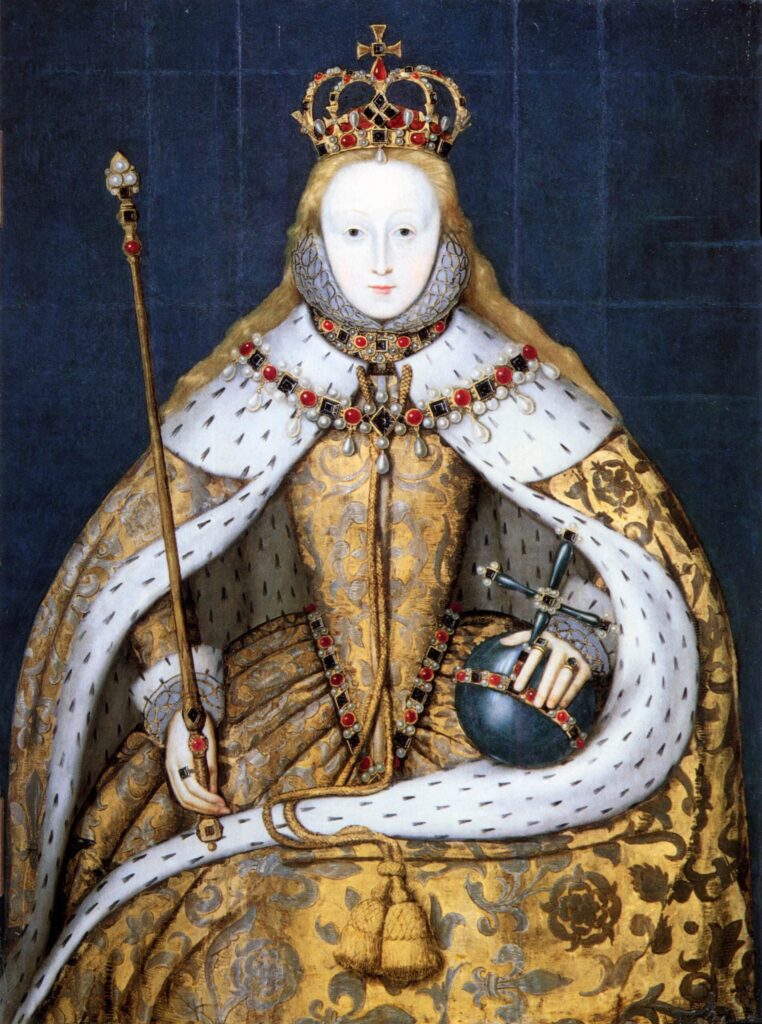
I know I have the body of a weak and feeble woman; but I have the heart and stomach of a king, and of a king of England too”
– Queen Elizabeth I (Tilbury speech)
Background
Summary of “The Winter’s Tale”

Leontes, King of Sicilia, wrongly accuses his wife, Hermione, of an affair with Polixenes, the King of Bohemia, driven by jealousy. Hermione gives birth to Perdita, but due to Leontes anger, he abandons baby. Hermione is put on trial for adultery then wrongful imprisoned. Their son, Mamillus, dies of grief, and Hermione, heartbroken, also dies. Perdita is raised by a shepherd in Bohemia, unaware of her royal lineage. Years later, Perdita attracts Polixenes’ son, Prince Florizel. When Polixenes forbids the match, Camillo, a former lord of Leontes, helps Florizel and Perdita flee to Sicilia. There, Perdita’s true identity as Leontes’ daughter is revealed. Paulina, Hermione’s lady in waiting, shows Leontes and Perdita a statue of Hermione and when the statue is unveiled, Hermione comes to life, and it is brought Leontes attention that she has been alive this whole time. Hermione forgives Leontes, and the family is reunited.
William Shakespeare (1564-1616)
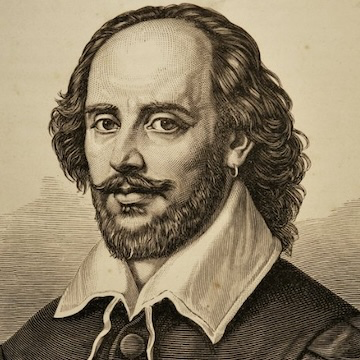
William Shakespeare was a playwright from England. He is known to be one of the greatest poets and storytellers of his time, creating famous works such as Othello, Romeo and Juliet, Hamlet, etc. The Winter’s Tale was written toward the end of this career; was first performed 1611, but wasn’t published until 1623 (French). The play is based on Robert Greene’s play Pandosto: The Triumph of Time; it has the same plot, but the names of the characters were changed (French). Most of Shakespeare’s muses usually come from other authors, pop culture, and politics. Shakespeare lived under Elizabeth’s rule and was speculated to be a church-papist; he occasionally attended catholic masses when and where they could, but also attend the church of England (Mater Amabilis).
Historical Context
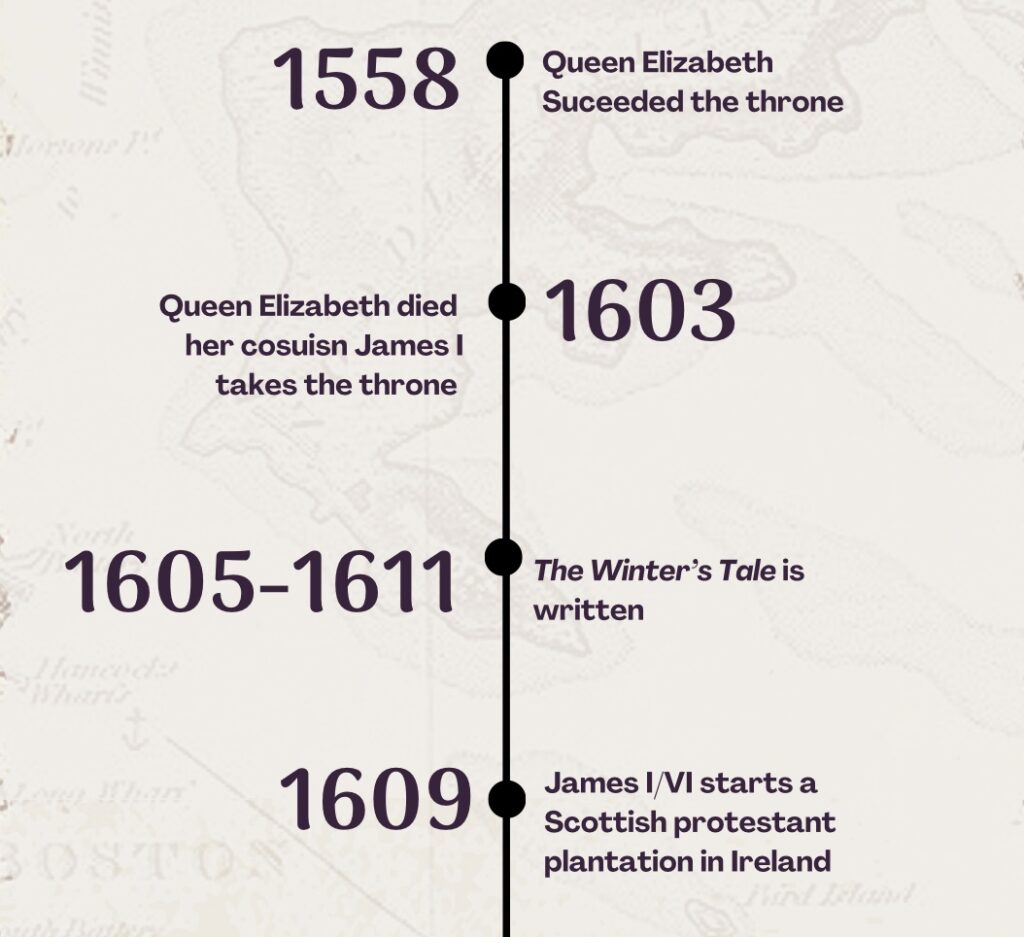
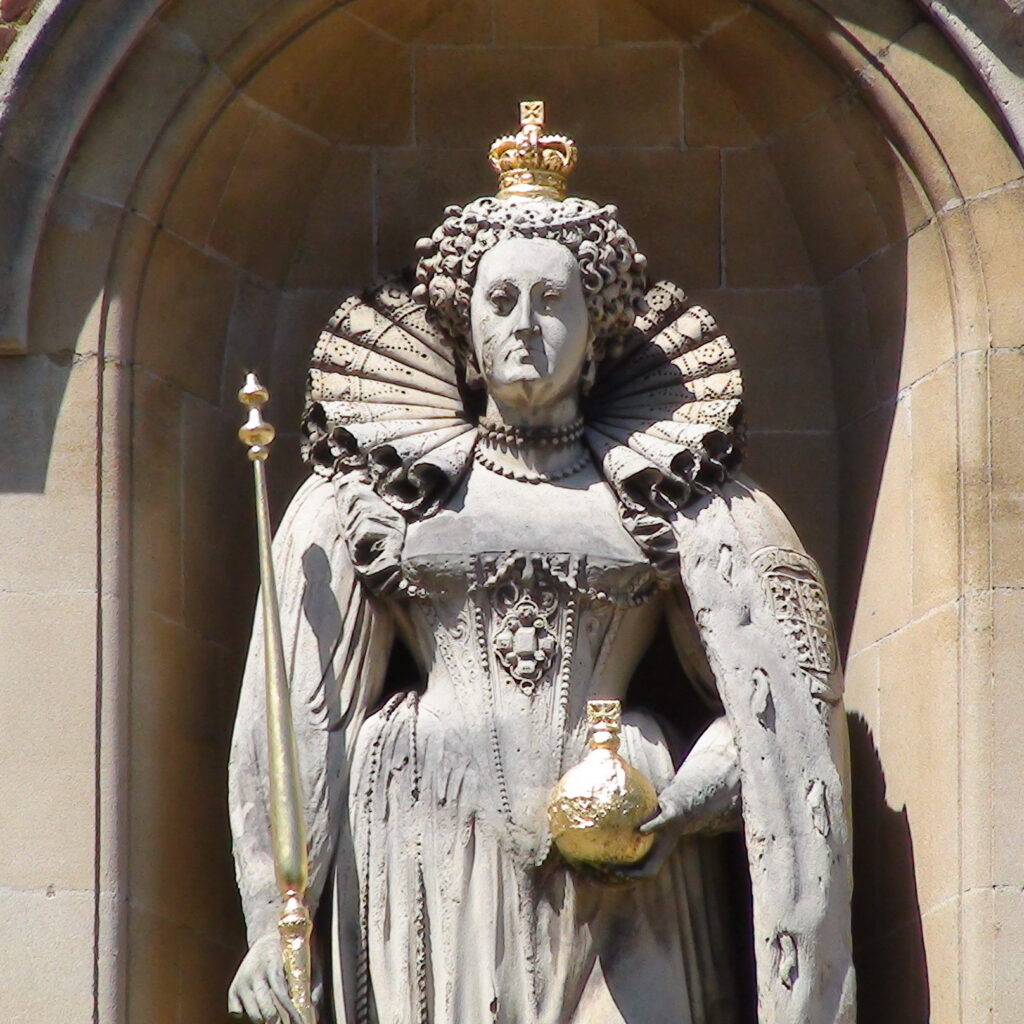
Who was Queen Elizabeth?
Image of a Body Politic
One of the challenges Queen Elizabeth I faced during her reign was the skepticism surrounding her authority due to her gender. Many people questioned her ability to rule because she was a woman; however, Elizabeth used the metaphor of the body politic to refute peoples claims. Her subjects saw her as “a body natural and a body politic” (Booth 14). This meant she ruled as a queen but had the power and authority of a king. Additionally, Elizabeth used peoples gender doubts to her advantage, strengthening her power. She ruled as an absolute monarchy with a small group of male advisors she would consult with occasionally. Consolidating the royal rule, ultimate authority was hers.
Virgin Queen
Queen Elizabeth was often referred to as the Virgin Queen. While it is clear she was not actually a virgin, this image played a key role in strengthening her public persona as being “married” to England. It showed her dedication to the people and her rule; reinforced that she is and will be a powerful independent leader. She embodied traits such as love, hope, wisdom, power, and unity.
I will marry as soon as I can conveniently, if God take not him away with whom I mind to marry, or myself, or else some other great let happen” -Queen Elizabeth; Response to Parliamentary Delegation on Her Marriage, 1566
The image of the “Virgin Queen,” along with associations to Venus, the goddess of love, were casted upon Elizabeth when portrayed in literature and art. She was often depicted alongside other goddesses and religious symbols, emphasizing her purity, and power (Hankins). She appeared almost mythological to the people; an untouchable figure who could do no wrong.
Queen Elizabeth I & The Three Goddesses
Religious settlement
Due to the turmoil caused by tensions between Catholics and Protestants from the previous rulers, Elizabeth sought to resolve these conflicts and create a more tolerant nation. In 1559, she declared the Church of England Protestant, separating it from the Roman Catholic Church and the Pope, through the Act of Supremacy. Although not completely tolerant, comparably, to other rulers, she accepted both religions. Catholics were allowed to practice their faith and attend Mass at churches where it was allowed, but they were also required to attend Church of England services every Sunday. These Catholics became known as the “Church Papists”. If they did not attend the Church of England they were penalized with recusancy fines, which initially were set at one shilling per week (Mater Amabilis). Catholics who caused no trouble were largely left alone, but those who refused to comply with the laws or failed to pay the fines could face imprisonment or death. As time went on, Catholics became more distrusted, particularly as tensions with Spain grew. Recusancy fines were raised, and at times, simply being Catholic could lead to imprisonment or death (Mater Amabilis).
a philosopher-queen whose studies gave her the perspective necessary to transcend myopic sectarian divisions” (Shenk)
Increasing Nationalism
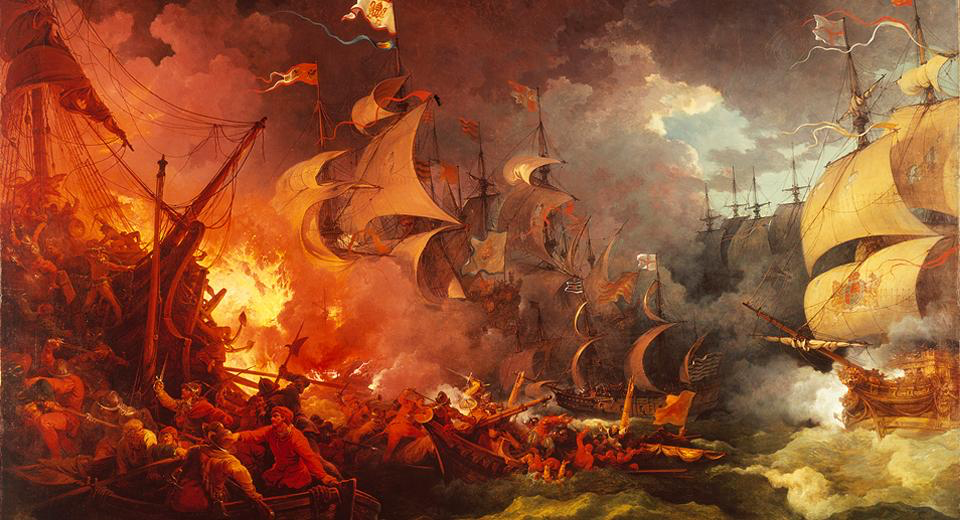
During the Anglo-Spanish War, the English army and navy were not on the same scale as those of Spain. In 1588, King Phillip II of Spain sent the Spanish Armada to invade England. However, the English navy successfully combated the Spanish fleet, and claimed victory. Following the defeat, Queen Elizabeth delivered her famous speech to the troops at Tilbury, where she expressed confidence in her soldiers and inspired hope for England’s future, building England’s national pride.
Interpreting a Winter’s Tale
Once Elizabeth died many people feared the political instability that was to follow. There was an unknown to how the nation would respond (Royal Museums of Greenwich). The central core of England who was loved by most for the past 45 years was gone. Would her legacy live on? Unrest spread throughout the community, and many novelists, playwrights, and artists reflected this turmoil in their works. Which is why, Some critics argue that Shakespeare’s The Winter’s Tale is a portrayal of this unrest and tribute to the legacy of Queen Elizabeth.
Hermione’s Character
Protector
Click here to read more.
Hermione, like Elizabeth, is a protector to those around her. Leontes sends Hermione away and Mamillus grows ill. Leontes says, “He straight declined, droop’d, took it deeply, / Fasten’d and fix’d the shame on’t in himself, / Threw off his spirit, his appetite, his sleep, / And downright languish’d” (2.3.16-19). Hermoine is protector of Mamillus and when she is no longer present to support him, he grows ill. This relates to Queen Elizabeth reigning as a Body Politic and was seen as a protector for her people. Just as Mamillius suffers in Hermione’s absence, the people of England fear they will face anxiety and instability without Elizabeth’s guidance, once she dies.
Power and Unity
Click here to read more.
Once Leontes is told of Hermione’s death, he is consumed by guilt, realizing that not only has he lost his wife, but his lineage has also been destroyed. He pleas, “Shame perpetual… tears shed there / shall be my recreation: so long as nature / will bear up with this exercise, so long / I daily vow to use it. Come and lead me / unto these sorrows” (3.3. 264-269). Leontes vows to live in a state of perpetual shame and despair, mourning the loss of his wife and “good queen” (2.2. 73). He exists in a state of constant anxiety and self-punishment. This turmoil mirrors the anxiety of the people following the death of Queen Elizabeth I. This moment highlights Hermione’s power: through Leontes’ own actions, mirroring the power of Queen Elizabeth.
Trial Speech and the Tilbury Speech
“Sir, spare your threats. / The bug which you would fright me with I seek” (3.2. 99-100).
Death doesn’t scare her, she will say what she must to defend herself showing authority in a male dominated society.
“I tell you / ‘Tis rigor and not law” (3.2. 121)
Pointing out to Leontes his actuations are not backed up by any real proof other than his jealousy, which is unfair how he can prosecute her just because he is a man and she is a woman. This shows her confident assertiveness over the situation.
Hermione’s speech resembles one given by Elizabeth; the speech to the Troops at Tilbury. In her speech, Elizabeth asserts her rightful place as queen, regardless of what others may say. She declares, “I have the body of a weak and feeble woman; but I have the heart and stomach of a king” (Royal Museums Greenwich). Elizabeth makes it clear that she is here to rule and will do so to the best of her ability, overcoming the constraints of the patriarchy
Rebirth and Lasting Legacy
Hermione comes back alive at the end of the play ending all of Leontes suffering, he would do anything to talk to her, he even forgives her. He proclaims, “O royal piece, / There’s magic in thy majesty, which has / My evils conjured to remembrance and / From thy admiring daughter took the spirits, / Standing like stone with thee” (5.3. 45-49). In this moment, Leontes defies the patriarchal expectations of society, submitting to Hermione’s female power. When she returns to life, everything is restored to its rightful place, but better than before. The family is reunited except Mamillus, but including Perdita, symbolizing that the lineage will continue, but through women.
There is hope for the future of England, and Elizabeth’s female authority and legacy will live on even after death. Shakespeare is making this connection to settle the anxieties the people may feel about England’s future following Elizabeth’s passing. Political stability will continue, and the queen’s legacy will live on.
References
Shakespeare, William. The Winter’s Tale. Edited by Barbara A. Mowat and Paul Werstine, Folger Shakespeare Library, 1998.
Booth, Teddy W. II, “A Body Politic to Govern: The Political Humanism of Elizabeth I. ” PhD diss., University of Tennessee, 2011. https://trace.tennessee.edu/utk_graddiss/1061
Penal Times Begin: Catholics Under Elizabeth I. materamabilis.org/ma/subjects/history/introduction-to-british-history-2/our-ladys-dowry/penal-times-begin-catholics-under-elizabeth-i.
Shenk, Linda. “Learned Queen: The Image of Elizabeth I in Politics and Poetry.” Book Reviews, vol.42, no.2, 2010, 262
“Queen Elizabeth I’s speech to the troops at Tilbury.” Royal Museums Greenwich, www.rmg.co.uk/stories/topics/queen-elizabeth-speech-troopstilbury#:~:text=Queen%20Elizabeth%20I%20used%20her,defining%20moments%20in%20British%20history.
Orgel, Stephen. “A Modern Perspective: The Winter’s Tale.” Folger Shakespeare Library, www.folger.edu/explore/shakespeares-works/the-winters-tale/the-winters-tale-a-modern-perspective/. Accessed 11 Dec. 2024.
Poltrack, Emma, et al. “How We Got ‘The Winter’s Tale’ and Where It Went from There.” Folger Shakespeare Library, 30 Mar. 2018, www.folger.edu/blogs/shakespeare-and-beyond/how-we-got-the-winters-tale-and-where-it-went-from-there/#:~:text=Scenes%20from%20The%20Winters%20Tale,and%20an%20“upstart%20crow.”&text=The%20editors%20of%20the%20Folger,into%20a%20full%2Dblown%20scene.
Elizabeth I, Speeches, 1566-1601. history.hanover.edu/courses/excerpts/165elizabeth.html.
Greenblatt, Stephen J., and John S. Morrill. “Elizabeth I | Biography, Facts, Mother, and Death.” Encyclopedia Britannica, 29 Oct. 2024, www.britannica.com/biography/Elizabeth-I/Accession.