Hudson R. Chen
Introduction
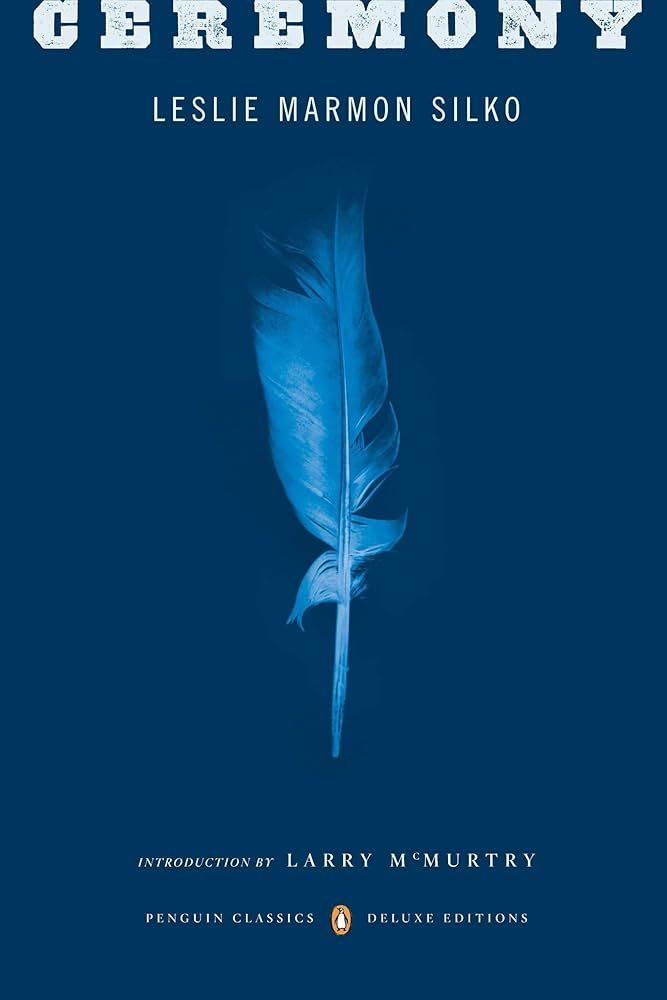
The chosen literary work is one written by Leslie Marmon Silko, named The Ceremony, it goes over a war veteran named Tayo and his journey through: guilt, grief, and belonging. Tayo is a mixed indigenous American who had a white father and an indigenous mother, this caused him to become alienated from the rest of his people as he was seen as different. It is also revealed that Tayo is a combat veteran who has recently returned, and it is because of all the trauma he has endured as a veteran that he finally decides to undertake the Ceremony. Author, Leslie Marmon Silko, similar to Tayo is of Laguna Pueblo descent, this connection with the author, generates greater insight into the culture and traditions of the Laguna Pueblo. Not only this, but The Ceremony, was the first book published by a Native American woman in the United States. Continuing on, The Ceremony was published in 1977, this date is in the historical proximity of World War 2, which ended in 1945. The reason for this date’s significance is due to the war’s heavy influence on Tayo, which was the main reason for his undertaking of the ceremony. The book’s underlying message that addresses PTSD in ethnically diverse veterans generates further significance. With the book being widely acclaimed and even “helped Silko secure a MacArthur “genius” grant in 1981” (Ibrahim). 1981 was also the first year such an award was given, and in the lifetime of the MacArthur grant, only 6 were women.
WW2 and Its Effects on The Ethnically Diverse

(Image shows the quantity of certain ethnical groups in the military, during World War 2)
The cultural referent being addressed would be, the greater difficulties ethnically diverse veterans faced when confronting Post Traumatic Stress Disorder (PTSD). As can be seen above, during WW2, over a million minorities held positions in the military (Research Starters: US Military by the Numbers), however this figure does not grasp the full scope as not all minorities served in segregated units. And, though such a large number of ethnically diverse soldiers were present in the military, racism and discrimination still ran rampant; this was especially true for African American soldiers. It was reported that within the military bases, “there were separate blood banks, hospitals or wards, medical staff, barracks and recreational facilities for Black soldiers” (Clark). Moreover, the inequalities these soldiers were subjected to were a major factor in the increased likelihood of PTSD, with a statistic demonstrating that rates of PTSD “were higher among African American (27%) and Hispanic (20%) veterans than among White veterans (13.7%)” (Williams et al. 1). Furthermore, “Two large studies reported that Black Veterans with PTSD are less likely to be awarded SC for PTSD than White Veterans (Murdoch et al., 2003; Redd et al., 2020)” (Spoont et al. 3). SC in this case stands for Service Connection, that is an injury or illness connected to service .
The denial of SC (Service Connection) naturally causes great damage to the financial wellbeing of veterans, with the increased likelihood of both receiving PTSD and being denied aid, a clear vision of inequality can be seen. Being discharged from the military can also be difficult for ethnically diverse veterans. This is due to the fact that in multiple foreign countries, these diverse groups were treated better than they were back in the states. This was evident in Britain, with an African American Journal stating, “They are inclined to accept a man for his personal worth” (Charles). Though the British were not without racism, they were said to have been appreciative of the ethnically diverse troops.
However, once back in the US, such privileges were stripped. And, for ethnically diverse groups, who have already had “historical trauma” (Ford et al.), PTSD is an even more difficult mental illness to overcome. It is also stated that such trauma “has on not only the immediate targets but moreover on their progeny for generations afterward” (Ford et al.), creating generational trauma which may result in a cycle of unresolved trauma for generations.
Better Understanding of The Ceremony
To continue, the cultural referent implicates the increased rate of PTSD that are afflicted onto culturally diverse veterans. This piece of information can explain why the friends of Tayo all seem to be suffering and resort to liquor, as a way to numb their pain. Though not explicitly stated, the constant drunk encounters throughout the story clearly depict such a scene. Moreover, the idea that foreign countries treated ethnically diverse soldiers with greater respect, was similarly depicted in The Ceremony. The scene features Helen Jean in a bar with war veterans, these veterans talk about how the white women “couldn’t get enough of us” and how “this one …was in love with me” (Silko 152). The research into the cultural referent demonstrates the longing for respect that these soldiers want, reminiscing and drinking just to fulfill such a desire. Not only this, but it helped me understand that it wasn’t just the PTSD that these soldiers had to face, but it was also the way of life that they had to give up. The privileges they enjoyed, and ultimately the respect that they longed for. Added onto the fact that aid and SC were so difficult to acquire for these ethnically diverse soldiers, it creates a perpetual reliance on alcohol. Moreover, another piece of the story that this research into the referent helps me understand would be Auntie’s continuous disapproval of outside influences. Auntie states “I try to tell him to stay with our own kind” (Silko 85), this quote fully demonstrates the idea of Historical trauma and its underlying effects, which create a closed off community. This form of trauma also passes down through generations, with the Laguna Pueblo’s history, scattered with external violence and tragedies, it is natural for the community to become tighter and closed off. This is evident in the way Auntie disapproves of Josiah’s relationships, as well as her alienation of Tayo. To her, this is simply tradition, simply a preservation of their cultural significance. By maintaining a closed off community, alienating outsiders, the community will remain safe.
Works Cited
“Black Americans Who Served in WWII Faced Segregation Abroad    and at Home.” History.Com, A&E Television    Networks, www.history.com/news/black-soldiers-   world-war-ii-discrimination. Accessed 11 Dec. 2024.
Ford, Julian D., et al. “Social, Cultural, and Other Diversity Issues in the Traumatic Stress Field.” Posttraumatic Stress Disorder, U.S. National Library of Medicine, 2015, pmc.ncbi.nlm.nih.gov/articles/PMC7149881/#:~:text=Members%20of%20ethnoracial%20minority%20groups,of%20Asian%20or%20African%20descent).
Ibrahim, Ismail. “Leslie Marmon Silko Saw It Coming.” The New Yorker, 16 Apr. 2023, www.newyorker.com/culture/the-new-yorker-interview/leslie-marmon-silko-saw-it-coming.
Silko, Leslie Marmon. Ceremony. Penguin, 2009.
Spoont, Michele, and Juliette McClendon. “Racial and Ethnic Disparities in PTSD.” Edited by Mathew Friedman et al., PTSD Research Quarterly, National Center for PTSD, 2020, www.ptsd.va.gov/publications/rq_docs/V31N4.pdf.
“Research Starters: US Military by the Numbers: The National WWII Museum: New Orleans.” The National WWII Museum | New Orleans, www.nationalww2museum.org/students-teachers/student-resources/research-starters/research-starters-us-military-numbers. Accessed 11 Dec. 2024.
“‘they Treated Us Royally’ the Experiences of Black Americans in Britain during the Second World War.” Imperial War Museums, www.iwm.org.uk/history/they-treated-us-royally-the-experiences-of-black-americans-in-britain-during-the-second-world-war. Accessed 11 Dec. 2024.
Williams, Monnica, et al. “(PDF) Addressing the Impact of Racism on Veterans of Color: A Race-Based Stress and Trauma Intervention.” Addressing the Impact of Racism on Veterans of Color: A Race-Based Stress and Trauma Intervention, American Psychological Association, 2018, www.researchgate.net/publication/328815068_Addressing_the_impact_of_racism_on_veterans_of_color_A_race-based_stress_and_trauma_intervention.